New publication on complete genome and phenotypic characterization of Zobellella denitrificans MW1
We are pleased to share a new publication entitled “Complete genome and phenotypic characterization of Zobellella denitrificans MW1 reveal carbon source preferences and a phosphate-associated shift in polyhydroxybutyrate accumulation“, recently published in Microbiological Research. The study presents the first fully closed, circular genome of Z. denitrificans MW1, obtained by hybrid Illumina–Nanopore sequencing, and combines detailed genomic analysis with systematic flask- and bioreactor-scale cultivation experiments to provide an integrated view of this strain’s biotechnological potential.
Polyhydroxyalkanoates (PHAs), and in particular poly(3-hydroxybutyrate) (PHB), are microbially produced biodegradable polyesters with properties comparable to conventional plastics. Reducing the cost and environmental footprint of PHA production requires identifying robust microbial producers capable of growing on low-cost feedstocks under non-sterile or semi-sterile conditions. Z. denitrificans MW1 is a Gram-negative, halotolerant, facultatively anaerobic bacterium previously shown to accumulate high amounts of PHB from glycerol, yet its genomic basis remained unresolved.
The newly reported complete genome of Z. denitrificans MW1 (4.10 Mb; 63.6% GC) encodes a conserved phaCAB operon, multiple sucrose uptake and catabolic systems, and a canonical Pho regulon with polyphosphate metabolism genes (ppk, ppx). Ten CRISPR arrays and an intact prophage were identified, while no acquired multidrug resistance determinants were found. The genome is plasmid-free, which is favourable for phenotypic stability during long-term industrial cultivation.
Phenotypic flask-scale experiments demonstrated that sucrose, glucose, and fructose support the highest biomass formation and PHB accumulation, with sucrose yielding up to 76% PHB of cell dry weight (CDW) in 48 h. Sucrose-rich beet molasses sustained PHB accumulation both in flasks and in 5 L bioreactor batch fermentations, establishing beet molasses as a viable low-cost industrial feedstock for this strain. In addition, fed-batch bioreactor runs comparing high-phosphate and low-phosphate conditions revealed a striking difference: a low-phosphate process reached 53 g L−1 CDW with 78% PHB content, whereas a high-phosphate process reached only 23 g L−1 CDW with minimal PHB — an observation that points to phosphate feeding as a potentially powerful control variable for directing carbon flux toward polymer storage.
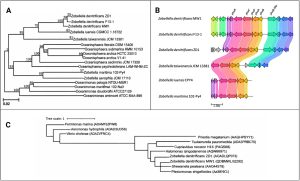
Structural modelling of the PHB synthase PhaC using AlphaFold 3 and comparison with homologous crystal structures from Aeromonas caviae, Cupriavidus necator, and Chromobacterium sp. USM2 identified a putative catalytic triad (Cys-324, Asp-481, His-509), consistent with known PHA synthase active-site architecture. Comparative synteny analysis confirmed that the phaCAB locus of MW1 is highly conserved relative to closely related Z. denitrificans strains ZD1 and F13-1.
https://doi.org/10.1016/j.micres.2026.128785