New publication on the enzymatic degradation and microbial upcycling of agricultural PBAT mulching films
We are pleased to share a new scientific publication entitled “Complete enzymatic degradation and microbial upcycling of agricultural PBAT mulching films”, recently published in the Journal of Environmental Chemical Engineering. The study presents an integrated approach for the degradation and valorization of poly(butylene adipate-co-terephthalate) (PBAT)-based agricultural mulching films, combining enzymatic depolymerization with microbial bioconversion to recover valuable compounds from plastic waste.
PBAT is a biodegradable polyester widely used in agricultural mulching films as an alternative to conventional plastics. However, despite its biodegradability, PBAT can persist in agricultural soils for extended periods, highlighting the need for effective waste management and recycling strategies. Enzymatic depolymerization offers a promising approach for breaking down polyester-based materials into their constituent monomers, which can subsequently serve as feedstocks for the production of value-added compounds.
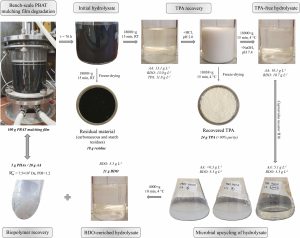
In this work, the researchers identified the engineered polyester hydrolase LCCICCG as the most effective enzyme among those investigated for PBAT degradation. The enzyme was subsequently applied in a stirred-tank reactor to process 100 g of commercial PBAT-based mulching film, achieving extensive depolymerization and releasing approximately 75 g of water-soluble degradation products within 76 hours. The resulting hydrolysate contained adipic acid (AA), 1,4-butanediol (BDO), and terephthalic acid (TPA), which were further processed to enable the recovery of valuable chemical building blocks.
A key outcome of the study was the successful integration of enzymatic degradation with microbial upcycling. Following the recovery of TPA, the remaining hydrolysate was used as a carbon source for Cupriavidus necator H16. Under nitrogen-limited conditions, the bacterium predominantly assimilated adipic acid and accumulated PHAs, biodegradable biopolymers with potential applications as alternatives to conventional petroleum-based plastics. PHA content reached approximately 86% of cell dry weight, while the 1,4-butanediol fraction remained unconsumed, offering the possibility of recovering it as an additional valuable co-product.
Overall, this study demonstrates the potential of combining enzymatic depolymerization and microbial conversion to transform agricultural plastic waste into valuable chemical building blocks and biopolymers. By moving beyond plastic degradation towards the recovery and biological valorization of its constituent monomers, the proposed approach contributes to the development of circular and more sustainable strategies for plastic waste management.
https://doi.org/10.1016/j.jece.2026.123528